From Energy Harvesting to Nerve Healing: Newly Patented UCR Technology Shows Promise for Regenerative Medicine
A newly issued U.S. patent awarded to UC Riverside researcher Dr. Jin Nam covers a regenerative medicine technology that represents an advancement in approaches to promoting nerve repair and healing.
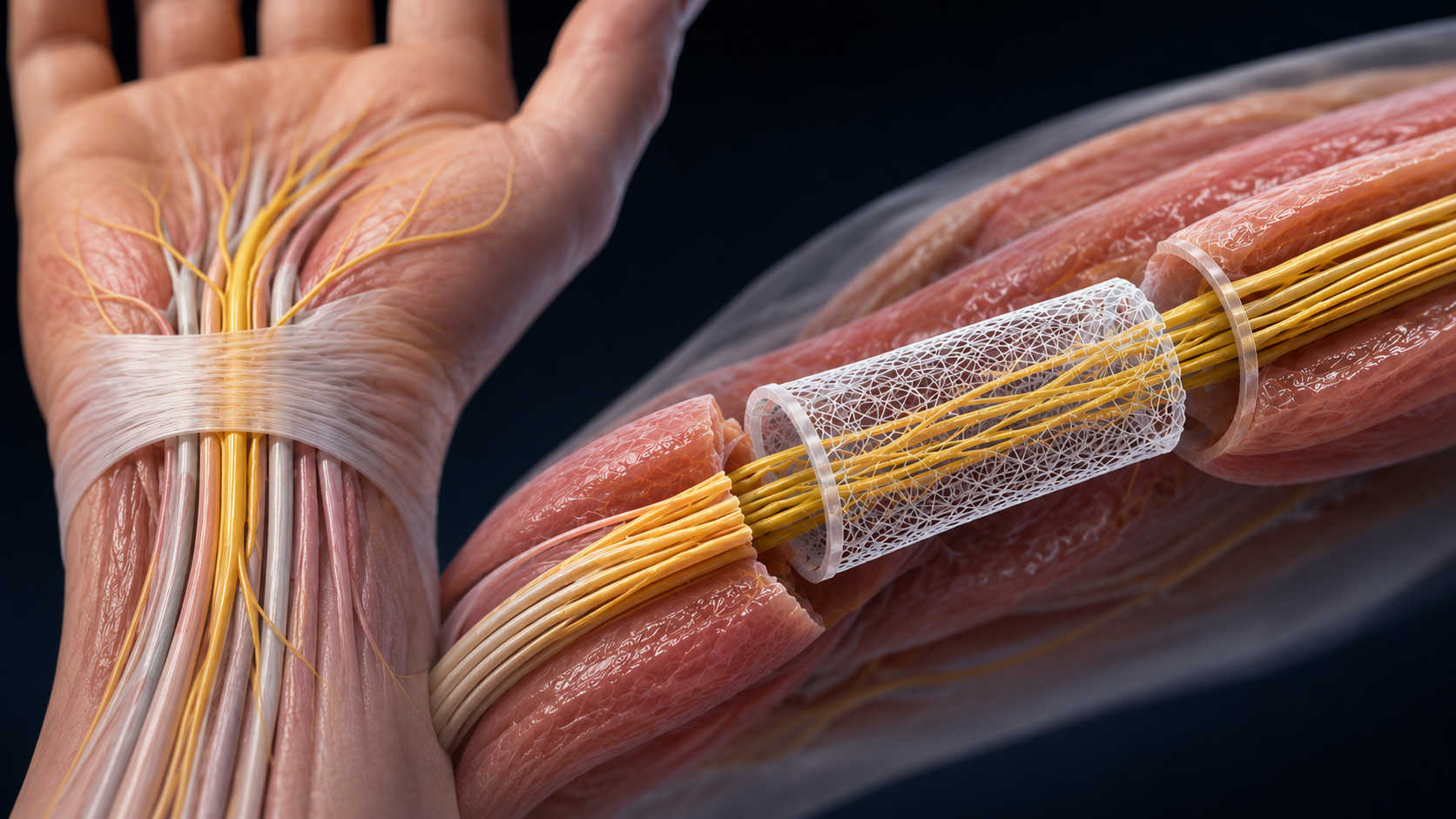
U.S. Patent No. 12,616,779, titled "Piezoelectric Scaffold Material and Its In Vivo Activation for Nerve Regeneration," was issued by the United States Patent and Trademark Office on May 5, 2026. The patented technology utilizes piezoelectric biomaterials—materials that generate electrical signals when subjected to physical forces such as movement or pressure—to create a localized environment that encourages nerve repair and regeneration without traditional implanted electrical devices.
The milestone builds upon years of research aimed at addressing one of regenerative medicine's greatest challenges: restoring damaged nerve connections following traumatic injuries and neurological disorders.
Imagine surviving a serious car accident only to learn that damage to your spinal cord may permanently affect your ability to move, feel, or function independently. While modern medicine can help stabilize injuries and manage symptoms, restoring damaged nerve connections remains one of the greatest challenges in regenerative medicine. For patients living with traumatic nerve injuries, spinal cord damage, and other neurological conditions, effective therapies that can help nerves regenerate are still limited.
At UC Riverside, Dr. Jin Nam is developing a patented "smart nerve guidance" technology designed to help address that challenge. The technology utilizes piezoelectric biomaterials—materials capable of generating electrical signals when subjected to mechanical forces—to create a localized environment that encourages nerve repair and regeneration without traditional implanted electrical devices.
"Our body has all kinds of cells that respond to physical stimulation—that's fundamental biology," said Nam. "This device enables physical stimulation to the cells in a controlled manner so that we can control them inside the body. One application is nerve regeneration."
Nam's research is rooted in the emerging field of physicobiology, which examines how physical forces influence cellular behavior. While many regenerative medicine approaches focus on pharmaceuticals, biologics, or stem cell transplantation, his work explores how carefully controlled physical and electrical cues can help guide cells toward repairing damaged tissue.
The technology is being investigated for applications in nerve regeneration and spinal cord injury treatment, where restoring communication pathways between damaged nerve cells remains a significant scientific and clinical challenge. Researchers have already demonstrated the technology's promise in preclinical animal studies, showing enhanced nerve regeneration and the ability to influence stem cell behavior through controlled physical stimulation.
"There are currently very few effective therapies available for regenerating damaged nerves," said Nam. "Our goal is to develop a platform that can help direct and support the body's own healing processes."
An Unexpected Discovery
The project did not begin as a regenerative medicine technology.
Around 2015, Nam's laboratory was investigating energy harvesting and organic piezoelectric materials capable of generating electricity from movement. The original goal was to develop materials that could potentially power wearable devices by converting mechanical energy into electrical energy.
Then an idea from one of Nam's Ph.D. students changed the direction of the project.
"One day, my Ph.D. student suggested that instead of using the generated electricity to power devices, we could use it to stimulate nerve cells," Nam recalled.
The team began exploring whether piezoelectric materials could be used to influence stem cell and neural cell behavior. Their laboratory became one of the first groups to demonstrate how piezoelectric stimulation could be used to control stem cell activities and promote regenerative responses, helping establish a new area of investigation that has since attracted growing interest from researchers around the world.
What began as a materials science and energy harvesting project gradually evolved into a regenerative medicine platform with the potential to address some of the most difficult challenges in nerve repair.
From Discovery Towards Translation
The early development of the technology was supported through Proof of Concept (POC) funding provided by UC Riverside's Office of Technology Partnerships as part of the university's broader Innovation & Entrepreneurship ecosystem.
The funding enabled Nam's team to generate proof-of-concept data, demonstrate technical feasibility, and de-risk the technology, laying the foundation for future translational research and partnership opportunities. The project ultimately led to U.S. Patent No. 12,616,779, "Piezoelectric Scaffold Material and Its In Vivo Activation for Nerve Regeneration," which was issued by the United States Patent and Trademark Office (USPTO) on May 5, 2026. The issuance of a patent by the USPTO now provides concrete claims to show what is covered by the patent which will support the translation of the technology from early proof-of-concept research toward future partnership and licensing opportunities.
Today, the technology continues to advance through ongoing research efforts focused on nerve repair and regenerative medicine applications. While additional funding and development work will be necessary to support future translational studies, the technology has already established a strong foundation through patent protection, peer-reviewed publications, and promising preclinical results.
UC Riverside's Proof of Concept funding program helps faculty innovators validate promising technologies, reduce technical risk, and position discoveries for commercialization opportunities. Funding opportunities are typically offered each spring and fall through the Office of Technology Partnerships. Researchers interested in future funding opportunities are encouraged to subscribe to the OTP newsletter to receive announcements about upcoming application cycles and innovation programs.
Looking Ahead
While Nam's current research focuses on acute nerve injuries and regenerative medicine applications, he believes the underlying platform may eventually have broader applications in chronic nerve damage and rehabilitation.
Acute nerve injuries such as those caused by traumatic accidents represent only a fraction of the patients who may ultimately benefit from regenerative technologies. Chronic nerve injuries and long-term neurological damage affect significantly larger patient populations and remain areas of substantial unmet medical need.
Regenerative medicine is an active area of research at UC Riverside, where faculty across engineering and biomedical disciplines are developing technologies aimed at repairing and restoring damaged tissues. In addition to Nam's work in nerve regeneration, researchers including Bahman Anvari, Joshua Morgan, and Iman Noshadi are investigating biologically compatible materials and tissue scaffolds for regenerative applications, while Huinan Liu is advancing bioresorbable materials for implantable devices. Related efforts by Boris Park focus on developing tools to diagnose and monitor neurodegenerative diseases and peripheral neuropathies. Together, these complementary areas of expertise position UCR as a growing center for regenerative engineering and translational biomaterials research.
This collaborative environment highlights the promise of combining materials science, engineering, and biology to develop new approaches to tissue repair. Looking ahead, Nam believes that understanding how physical signals influence cell behavior could unlock entirely new possibilities for regenerative medicine.
"We are only beginning to understand how physical signals can influence cell behavior," said Nam. "As we continue to learn more, we may be able to develop new ways to help tissues regenerate and recover from injury."
The work represents the convergence of engineering, biology, and medicine—and a reminder that some of the most promising innovations emerge when researchers are willing to follow unexpected discoveries. What began as an effort to harvest energy may one day help restore the body's ability to heal itself.
Technology Available for Licensing
Dr. Nam's piezoelectric nerve regeneration technology is currently available for licensing through UC Riverside's Office of Technology Partnerships.
Organizations and/or entrepreneurs interested in exploring licensing opportunities, sponsored research collaborations, co-development partnerships, or additional technical information are encouraged to contact Grace Yee.
Contact:
Grace Yee
Assistant Director
Email: otc@ucr.edu
Phone: (951) 827-2212
Patent Information:
Patent Number: U.S. Patent No. 12,616,779
Title: Piezoelectric Scaffold Material and Its In Vivo Activation for Nerve Regeneration
Issued: May 5, 2026
UC Case Number: 2018-276
Status: Issued
Technology: Piezoelectric nerve guidance scaffold technology for nerve regeneration and repair
Click Here For Patent Link
Interested in staying informed about new technologies, funding opportunities, startup programs, and innovation initiatives? Subscribe to the Office of Technology Partnerships newsletter to receive the latest updates from UCR's Innovation & Entrepreneurship ecosystem.